About Me

My photo
I am the studio teacher in Zach's Place Studio, an AMS Montessori teacher, an artist, a mother and much more.

Saturday, October 16, 2010

week 6- Toddlers- Angelina

Watching toddlers in their classroom environment quickly illustrates the developmental importance of sensorial experiences. Their interest is captivated by the sound of a cup against the surface of a table, the feel of water, the taste of the graham crackers and strawberries served for snack. Their explorations often begin with a full body approach. With this in mind and a brief consult with the toddler teachers we decided to bring the leaves to the children in the form of an excercise in sensory exploration.We set out two large plastic tubs. One full of leaves, dried corn and acorns, while the other tub was left empty. The students transfered the leaves between the tubs, watched the leaves twirl to the floor, listened to the rustling sounds of leaves and corn husks, smelled the aromas of autumn and foliage.
Two of the older students in the class expressed an interest in a tub of leaves big enough to play in. This idea has prompted our provocation for next week, a small swimming pool filled with fallen leaves to explore.

Thursday, October 14, 2010

week 6- From line to leaf- Angelina

The wonder of Autumn through the eyes of a child is something many of us may take for granted. The brightly changing leaves are a thing of magic and breathtaking majesty. A child in our program is of an age that he or she may only remember one or two forays into the colorful world of Autumn. It is our hope, as partners in learning, to nurture this appreciation of the natural world as each child develops and matures into a responsible steward of our planet. Partly with this in mind and party with giddy excitement for the seasons, we continued our exploration of line to include an exploration of leaf.After bringing in overflowing baskets of fall inspirations, we began our inquiry into the great changes taking place in our surroundings.
When we approach a new topic we start with a question, many of them beginning with: "I wonder...", "Have you noticed...". We pursue the child's learning with additional questions, like, "Why do you think that happened?" or "What might happen next?". The teacher, as participant, researcher and observer, records each answer.
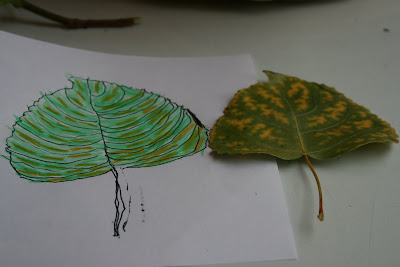
I am always startled by the freshness and insight of their ideas and explanations. While we talk, we often draw.Some students traced the leaves while others made free handed representations.This child created an elaborate piece, carefully placing each leaf on the page after removing it from its stem and tracing around its curving form.As the children worked together, conversation ebbed and flowed, during this process several possible ideas emerged for a project. One centered around creating a tree for the school, with real leaves falling to the ground. Another idea involved pressing leaves into sand or mud to create a collage of leaves.Still other ideas involved categorizing leaves, or capturing them before "the fall".Once the rains cleared, students began sojourning onto the playgrounds in search of a particular leaf to explore and draw. Many of the older students chose to make leaf books, each page a record of a particular leaf and the child's process of looking.One student became very intrigued by the idea of ephemeral art in the style of Andy Goldsworthy. He spent over twenty minutes immersed in Goldsworthy's book, Passages, and spontaneously began drawing images from the pages, creating a collection of "art ideas" to add to his leaf book.

We have sent home a project for our community consisting of a brown paper lunch bag and an invitation to fill it with signs of the season. Next week we plan to begin categorizing these items for the many projects and explorations ahead.
Thursday, October 7, 2010

week 5-Intro To Clay- Amy

It is wonderful being back in the Art Studio at Children's Garden and a great gift to be working with Angelina and Kathryn. Clay is one of my favorite mediums to work in as a mixed media sculptor. This week I had the opportunity to meet most of the children and start a dialogue about clay.

We talked about how the clay feels in our hands; where clay come from; why it is different from the play-dough in their classroom; what happens when you add too much water and what happens when it is too dry. We used our hands to create spheres, coils and press the clay into different forms. We also experimented with different clay tools and rolled clay out into a flat slab. I demonstrated the "score and slip" technique and how to use clay slip as "glue" to join pieces of clay together.

Some of the children created small sculptures that will need to dry and be fired before they can be taken home. Others chose not to keep their work and just enjoyed the tactile experience of working with clay.

I'm looking forward to continuing the clay dialogue with the children on Mondays and excited to see where our imagination and creativity will take us.


Parents helping with projects - Kathryn

For the first weeks of school, we discourage parents from visiting their children at school because seeing a parent during those first weeks of becoming used to school again can be a bit unsettling for a young child. But those weeks are past, and Children's Garden has been filled with moms helping groups of children with art projects. We have been so impressed with these moms - they "get" the atmosphere we are trying to create here - calm, relatively quiet, respectful of the children, slow-paced and focused. Yesterday as I walked through the classrooms, small groups of children huddled around tables filled with paint, beads, and pottery, working with a parent or two to complete a project. It reminded me of why we bring art into our school at all. There is something magical about the power of creating a thing of beauty, and for a child, that could be nothing more than a line on paper, a spot of color on canvas, or a string of beads on a wire.

The Toddlers: Here are a few photos of the toddlers painting small wooden objects. They are between 18 months and 3 years old, so the tools themselves are fascinating, hands become tools, for some there is the temptation to taste the paint (non-toxic is essential!!) and the paper beneath the figures also gets a good dollop of paint.


The Extended Primary: The extended primary children, all close to or by now five years old, have mastered most of the tools we use in the studio. They are beyond the exploratory stage of the toddlers, and are ready to do fairly refined and sophisticated work. Interesting to me is that both toddlers and five year olds fall into concentrate easily. The flow experience knows no age boundaries.

These children, with the help of two moms, are stringing fairly small beads of their own choosing, following a pattern of their creation, and then repeating that pattern several times. Obviously they are loving what they are doing, and because of the level of concentration, will return to their next work in the classroom calm and satisfied.


Wednesday, October 6, 2010

Clay with Amy - Kathryn

Angelina and I have been joined by the third member of the studio team, Amy Laugesan, who will be working with clay with the children from each classroom on Mondays. This week she spent three days with us so that she could meet everyone, and get thoroughly integrated into our program. Amy was the studio teacher for a year in 2004, so she is familiar with Children's Garden and knows a great deal about working with children and art. We're excited to have her join us.

This week her objective was simply to introduce clay as a medium, and give the children some experience and vocabulary for what they did. Some now know about rolling clay into a long tube, and making a sphere, about using slip to stick pieces together, and something about the process of putting clay into a special oven to cook so that it is hard.
Loris Malaguzzi, the educator who lead the development of the Reggio Emilia approach, wrote about the hundred languages of learning, and meant by that the countless ways children express their ideas, their questions, their curiosity. Using clay is one language, as is drawing, as is using paint, as is dance, is singing - the list goes on and on! One by one, or two by two, we will continue to introduce different ways for children to tell us what they are interested in.

Thursday, September 30, 2010

XP qualities of line- week 4- Angelina

The older students (extended primary or XP) have independent studio time every Wednesday afternoon. This week we met for a group discussion at our central tables. Kathryn and I were interested in bridging the exploration of line with the materials in the montessori environment. I began by asking a small group if they could think of any material in their classroom that might represent a "thick" or "thin" line. They came up with several possible ideas, until one student sat upright from an immersion in thought and said, "the brown stair". YES! They brought the thickest stair and the thinnest stair to the table. We spent some time examining the qualities of thick and thin, broad and narrow, "fat" and "skinny". Then I introduced them to a bevvy of black drawing tools on the table and said, "Do you think we could make lines that are thick and lines that are narrow?". The students were eager to experiment and soon discovered that certain tools were better for thin lines than thick ones and vice versa. I showed them how to run a crayon on its side along the smooth surface of paper, to make a very thick line and how to change the angle of a marker to alter the width of the line. Several students passed through the studio, each one experimenting with the thickness of line and variety of tools.

One boy accidentally discovered that he could, "make thin lines using thick lines". He was drawing with a ball point pen on white paper atop a drawing mat (which provides a slight cushion). He then turned the paper over and exchanged the pen for a charcoal pencil, experimenting with thick black lines. The charcoal residue began to adhere to the impression of his drawing from the reverse side of the paper. Without a word, he quickly grabbed the black crayon and rubbed the surface of the imprint. He looked at his work amazed and brought it to me. I in turn expressed my interest in his process and he demonstrated his findings to everyone gathered at the table. We were all excited by his discovery and soon several students were independently exploring his technique, with his guidance wherever needed. He was visibly satisfied by this opportunity to share with his classmates.

Later, I asked another group of students if they could think of some work in their classroom that was really long. We came up with lots of great ideas and then I offered a possible hint, "Is there something long and red in your classroom?". A unanimous chorus of "the red rods" sounded and two eager students hurried off to retrieve the longest red rod and the shortest red rod. (For anyone unfamiliar with either the red rods or the broad stair, they are standard Montessori sensorial materials that isolate length and width respectively)
.
After exploring and comparing the longest rod and the shortest rod, I asked if anyone was interested in trying to draw lines that are long or short. It would be an understatement to say that the students were eager. They were positively passionate about these materials which many of them began using more than two years ago. Several students decided to trace the rods and then fill in the long rectangular shape that resulted.
Another student chose to begin tracing each of the red rods on paper. At one point he called the second red rod "the two rod", with an obvious understanding of the similarity between the red rods and the number rods in his classroom.
This student, pictured below, began by tracing the shortest rod, but quickly progressed to filling in the drawn shape and elongating it into a bat, "a thick line". He then drew "thin lines" to create a baseball. Beneath the image he began carefully and deliberately to draw a scoreboard. This process fascinated him and after some effort, he glanced up and announced, "I'm making a pattern" and he was!
Another child chose to make one long, rambling line paired with a host of small dots.Several students commented on emerging patterns in their work. This student was making a color pattern. After a brief conversation with the XP teachers, I discovered that they have been discussing pattern in class and how line can be repetitive. This could be a good studio exploration for another day.

line and shape- week 4- Angelina

Our "slow down" week in the studio, certainly didn't imply a slowing down of student activity. The students were eager and excited to experiment with the many materials they had been introduced to thus far, including this malleable sculpting wire which progressed from lasso to pear and below you can see it's final incarnation as a bird. In the picture above, two students discovered that if two sculpting wires were joined together, a very long line resulted.
This week we initiated a daily drawing time, where each student draws something, possibly something memorable from their morning, on a 6x6 sheet of white paper prior to starting other studio activities. This is a great opportunity for us to discuss their day and it is a nice way to transition from the classroom into the studio. We will be keeping these drawings to catelog individual progression throughout the year.
The light table and projector continue to be hot spots of activity and creativity.
The students are utterly entranced by the projector, its mechanics and the magic of light transfered onto the wall. This is an obvious interest worthy of some consideration for a future project.
Several students blended colored shapes and lines to create interesting patterns and compositions. Some of the photos were shown to the students who created them, in an effort to prolong their process and allow for some elementary discussion of composition, pattern and balance. The students were interested in the photos and very willing to comment on their process and expression.
The students remain interested in line and have begun a chart of lines using some colored sculpting wire.
This activity still holds the interest of the students and several have expressed a desire to continue exploring types of line.

Next week, we plan to watch as this study of line continues to evolve adding the easel, black paint and several sized brushes to the mix.
Stay tuned.