 I have been documenting on blogs for years and one of the challenges of all documentation (blogs included) is the dependence on objectivity from a very human and subjective author. Which is to say that where the observer focuses becomes what the reader sees and hears about. As we all know, life is a complex web of movement, activity, experience and discovery. No matter how wide we train our eyes we are never able to fully track all of it and we are less able to impart some of it. As I work with children I watch for overlapping themes of interest. These string together and elucidate some aspect of how children learn and create themselves. These common threads are woven into blog entries, documentation panels and exhibit ideas. Yet, I am acutely aware that while attending to one thing, I am inclined to miss something else. For this reason I take lots of pictures and jot down pages of notes. I occasionally pass these pages out to my coworkers and together we read them, looking for intersects, like archaeologists sift through sand. It never ceases to surprise me, when something obvious rises to the surface that had been otherwise overlooked. The studio presently has an overt leaf project evolving that I will address in a later post, for now I would like to showcase some of the activities on the periphery. Those things that often go undisclosed, but may be the seeds of future projects, or simply an episode of discovery, beautiful in itself.
We have shelves stocked with a variety of tools: dot markers, oil pastels, markers, colored pencils, large crayons, etc. These tools are organized by color and available for exploration. There are pre-cut sheets of white drawing paper nearby. This student selected several dot markers and worked for ten minutes, carefully filling the page.
 This student made several paintings, this one he called "an evergreen on fire". His title was inspired by the palette of warm colors available, each brushstroke accompanied by an ongoing dialogue, a story emerging in color, line and paint.
 The light projector is a source of continuous intrigue. It has been in the studio since the start of the year and children are still somewhat shocked to see the image projected in scale. Many students stare at the bright surface of glass holding a leaf or stone and when their eye is directed to the translated image in shadow, they are giddy with excitement.
 Others are captivated by how it works. They examine the projector from all angles, exploring its mechanics with interest.
 This week, a child was moving the reflective mirror at the top and it snapped back on its hinge, shifting the light from the wall to the ceiling. She was amazed by what she saw. Soon several other students joined her, each eager to project a shadow on the ceiling. Light and shadow seems to be unanimously captivating to young children and continues to be a source of discovery in the studio.
 Another interesting evolution is an interest in the human body, particularly with the students in the 440 class and the extended primary students who have begun a study of the body, its parts and systems. This student arrived at school carrying a pencil sketch of a human skeleton that he had traced on the back of his brothers homework. He came into the studio and asked if he could "make it bigger". Of course, I said "YES!". He was deeply focused on this activity and continued drawing and painting for nearly thirty minutes.
 Those are just a few of the things emerging on the periphery of our leaf study. We will see how things evolve in the weeks and months ahead.

 We had a great response from our brown-bag invitation to explore autumn's splendor. Soon the studio was overflowing with a gorgeous array of color, moldering scents and crunching leaves. We spent several days organizing our loot into several categories determined by students. Some of them included: color,
  I have been talking to the students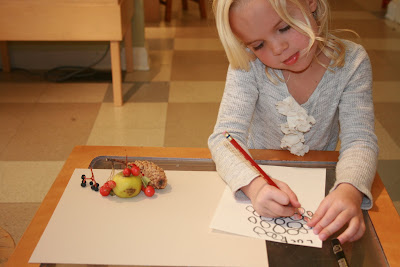
 Most of the students decided to draw their finished compositions, before replacing them in their defined basket or tray.
 The toddlers also explored leaf compositions indirectly, on the light table. They were equally interested in the process of
 Watching toddlers in their classroom environment quickly illustrates the developmental importance of sensorial experiences. Their interest is captivated by the sound of a cup against the surface of a table, the feel of water, the taste of the graham crackers and strawberries served for snack. Their explorations often begin with a full body approach. With this in mind and a brief consult with the toddler teachers we decided to bring the leaves to the children in the form of an excercise in sensory exploration.
 We set out two large plastic tubs. One full of leaves, dried corn and acorns, while the other tub was left empty. The students transfered the leaves between the tubs, watched the leaves twirl to the floor, listened to the rustling sounds of leaves and corn husks, smelled the aromas of autumn and foliage.

 After bringing in overflowing baskets of fall inspirations, we began our inquiry into the great changes taking place in our surroundings.
 When we approach a new topic we start with a question, many of them beginning with: "I wonder...", "Have you noticed...". We pursue the child's learning with additional questions, like, "Why do you think that happened?" or "What might happen next?". The teacher, as participant, researcher and observer, records each answer.
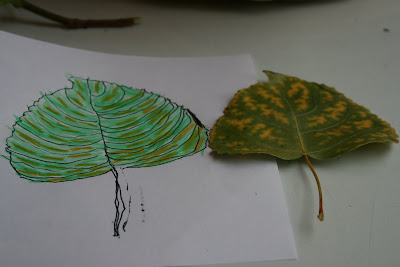 Some students traced the leaves while others made free handed representations.
 This child created an elaborate piece, carefully placing each leaf on the page after removing it from its stem and tracing around its curving form.
 As the children worked together, conversation ebbed and flowed, during this process several possible ideas emerged for a project. One centered around creating a tree for the school, with real leaves falling to the ground. Another idea involved pressing leaves into sand or mud to create a collage of leaves.
 Still other ideas involved categorizing leaves, or capturing them before "the fall".
 Once the rains cleared, students began sojourning onto the playgrounds in search of a particular leaf to explore and draw.
 Many of the older students chose to make leaf books, each page a record of a particular leaf and the child's process of looking.


